Frequently Asked Questions
1. What is Page Object Model in Playwright?
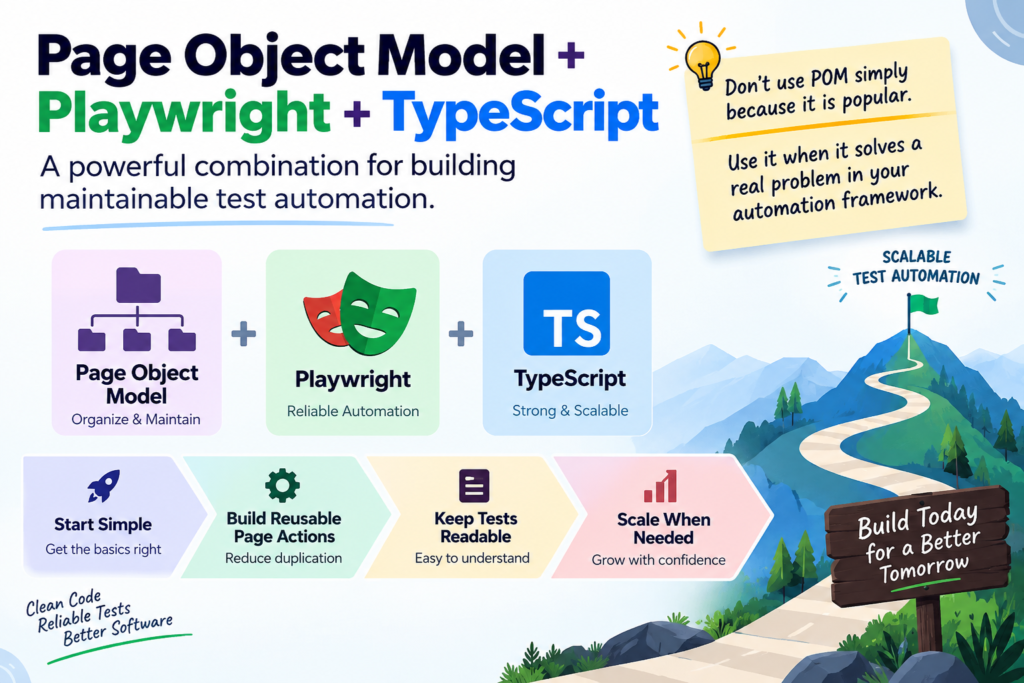
POM, or Page Object Model, is a design pattern where page locators and interactions are organized inside separate page classes.
Contents
2. Is POM required in Playwright?
No. POM is optional. It is mainly useful for organizing and maintaining larger automation projects.
3. Is POM suitable for beginners?
Yes. Beginners can start with a simple page object such as LoginPage and gradually learn more advanced framework design.
4. What language is commonly used with Playwright POM?
Playwright supports several programming languages. With TypeScript, page objects are commonly created using TypeScript classes.
5. Does POM reduce duplicate code?
It can. Common locators and page actions can be centralized and reused across multiple tests.
6. Should every Playwright test use POM?
Not necessarily. Small tests may not need it. POM becomes more valuable as the number and complexity of tests increase.
Conclusion
Other Internal Links:
- API Testing for Manual Testers: 7 Easy Steps to Master API Testing
- 20 Amazing SQL Queries Every QA Engineer Should Know
- AI for QA Engineers: 5 Powerful Ways to Use AI
- Manual Testing to Automation Testing: 7 Proven Steps to Boost Your QA Career
- Chatbot Testing: 7 Powerful Ways to Test Chatbots as a QA Engineer
- AI Playwright Automation: 10 Simple Ways AI Helps You Write Tests
- AI Agent Testing: 7 New Opportunities for QA Engineers
- 10 Playwright Mistakes Beginners Make — And How to Avoid Them
- 50 Playwright Interview Questions: Powerful Answers to Boost Your QA Career
- 50 Powerful Manual Testing Interview Questions to Ace Your QA Interview
- Real-Time Production Bug Interview Questions: 15+ Scenarios Every QA Should Know
- 10 QA Resume Mistakes That Reduce Shortlisting in 2026
- How to Handle Unrealistic Testing Deadlines: 7 Smart Strategies for QA Engineers
- Micromanagement in IT: 7 Smart Ways to Handle It Professionally
- AI Skills for QA Engineers in 2026: Must-Know Skills & Roadmap
- Manual Testing in 2026: The Ultimate Guide Dying or Evolving?