AI skills for QA engineers are becoming increasingly important in 2026 as artificial intelligence changes how software is developed, tested, and released.
- Opportunity 1: Use AI to improve testing
- Opportunity 2: Test applications that use AI
- QA tasks where prompt engineering can help
- Important rule
- A practical workflow
- But don’t become dependent on self-healing
- The goal
- Example QA prompt
- But remember
- Security warning
- Remember
- The golden rule
- QA engineers should understand
- Using AI to test software
- Testing software that uses AI
- What should you test?
- QA engineers should learn to ask:
- Level 1 — QA Fundamentals
- Level 2 — Technical QA
- Level 3 — Automation
- Level 4 — Generative AI
- Week 1: AI Fundamentals
- Week 2: Prompt Engineering
- Week 3: AI-Assisted QA
- Week 4: AI Testing
- 1. Learning every AI tool
- 2. Trusting AI blindly
- 3. Copying AI-generated automation
- 4. Ignoring manual testing
- 5. Ignoring data privacy
- 6. Chasing certificates without projects
- What AI skills should QA engineers learn in 2026?
- Will AI replace manual testers?
- Does a QA engineer need to learn machine learning?
- Is prompt engineering useful for testers?
- What is AI-assisted testing?
- What is AI testing?
- Should freshers learn AI before automation?
AI can now help QA professionals generate test scenarios, analyze requirements, create test data, write automation code, summarize defects, and explore large amounts of testing information.
But this doesn’t mean QA engineers are becoming unnecessary.
In fact, the role is evolving.
The important question for a QA professional in 2026 isn’t:
“Will AI replace QA engineers?”
It is:
“Which AI skills should I learn to become a better QA engineer?”
The answer isn’t that every tester needs to become a machine-learning engineer.
Instead, QA professionals should combine their existing testing knowledge with AI, automation, technical skills, critical thinking, and quality engineering.
Why Are AI Skills for QA Engineers Important in 2026?
The most valuable AI skills for QA engineers include prompt engineering, AI-assisted testing, automation, LLM testing, AI security, and AI evaluation.
That creates two opportunities for QA engineers.
Opportunity 1: Use AI to improve testing
For example:
Requirement → AI assistance → Test design → QA review → Execution
Opportunity 2: Test applications that use AI
For example:
User → Prompt → LLM → Response → Evaluation
These are two different skill areas.
ISTQB now separates them clearly: its CT-GenAI certification focuses on using generative AI in testing, while CT-AI v2.0 focuses on testing AI-based systems, including machine-learning systems and generative AI/LLM applications.
Therefore, QA engineers should learn both concepts gradually.
1. Prompt Engineering for QA Engineers
Prompt engineering is the skill of creating clear instructions for AI systems so they can produce useful results for a particular task.
For QA engineers, this is one of the easiest AI skills to start practicing.
Consider this prompt:
Generate test cases for a login page.
The result may be generic.
Now provide more context:
Act as a senior QA engineer. Create positive, negative, boundary, security, usability, and exploratory test scenarios for a login page containing email, password, Login, and Forgot Password functionality. Include Test ID, Scenario, Priority, Expected Result, and Test Type.
The second prompt gives the AI:
- Role
- Context
- Scope
- Testing techniques
- Output format
QA tasks where prompt engineering can help
You can create prompts for:
- Test case generation
- Negative scenarios
- Boundary testing
- API testing
- SQL assistance
- Test data generation
- Bug analysis
- Automation code
- Requirement analysis
- Test documentation
Important rule
Never assume that an AI-generated answer is automatically correct.
AI can misunderstand requirements or produce incomplete scenarios.
Your QA responsibility remains:
Generate → Review → Validate → Improve
ISTQB’s current CT-GenAI guidance specifically covers prompt engineering, evaluating AI-generated outputs, hallucinations, bias, privacy, and applying generative AI throughout testing activities.
2. AI-Assisted Test Case Generation
Creating test cases manually can take considerable time, especially when requirements are large.
AI can help QA engineers brainstorm scenarios quickly.
For example, imagine you are testing an online payment system.
You could ask AI to generate scenarios involving:
- Successful payment
- Failed payment
- Duplicate payment
- Payment timeout
- Network failure
- Double-click on Pay
- Payment succeeded but confirmation failed
- Refund failure
- Currency mismatch
- Session expiration
But there is an important distinction:
AI can generate possibilities.
QA engineers decide which scenarios actually matter.
A practical workflow
Requirement
↓
AI-generated scenarios
↓
QA review
↓
Risk analysis
↓
Final test cases
This prevents your test suite from becoming a collection of blindly generated scenarios.
3. AI-Assisted Test Automation
AI is also changing how automation engineers create and maintain tests.
AI-assisted automation can help with:
- Generating test scripts
- Explaining automation code
- Creating locators
- Suggesting assertions
- Debugging failures
- Refactoring code
- Test maintenance
- Failure analysis
Some modern testing platforms also provide AI-assisted test creation and adaptive/self-healing capabilities.
For example, mabl describes AI-assisted test creation, analysis, and auto-healing capabilities.
But don’t become dependent on self-healing
A QA engineer should still understand:
- Locators
- Assertions
- Wait strategies
- Page Object Model
- Test architecture
- Test data
- API integration
- CI/CD
- Debugging
If you’re learning Playwright with TypeScript, AI can help you write and understand code, but you should still learn TypeScript and Playwright fundamentals.
The goal
Not:
AI writes everything for me.
Instead:
AI helps me develop and maintain automation faster.
4. AI for Requirements Analysis
One of the most valuable applications of AI in QA is finding gaps in requirements.
Suppose you receive:
Users can reset their password using their registered email address.
There are many questions.
What happens if:
- The email doesn’t exist?
- The email is empty?
- The email contains spaces?
- The reset link expires?
- The user requests multiple reset links?
- The link is already used?
- The account is locked?
- The email service fails?
AI can help brainstorm these questions.
Example QA prompt
Review this requirement as a senior QA engineer. Identify ambiguous requirements, missing acceptance criteria, positive scenarios, negative scenarios, boundary conditions, security risks, and questions that should be clarified with the product owner.
This can move QA involvement earlier in the SDLC.
But remember
AI doesn’t know your business rules unless you provide them.
Therefore:
AI analysis + human business context = better requirements review
5. AI-Powered Test Data Generation
Test data is another area where AI can save time.
QA engineers can use AI to generate synthetic data for testing:
- User profiles
- Product records
- API payloads
- Addresses
- Transaction data
- Boundary values
- Invalid inputs
- Special characters
- Localization scenarios
For example:
Generate 50 synthetic customer records containing valid, invalid, boundary, and incomplete data for API testing.
This can help with functional testing, API testing, database testing, and automation.
Security warning
Never paste confidential production information into an AI tool unless your organization’s policies explicitly allow it.
Avoid sharing:
- Passwords
- API keys
- Production credentials
- Customer PII
- Confidential source code
- Sensitive business information
AI productivity should never come at the expense of data security.
6. AI-Assisted Defect Analysis
A large project can generate hundreds or thousands of defects over time.
AI can help QA teams analyze defect information.
For example, it can assist with:
- Summarizing defects
- Categorizing issues
- Identifying duplicate descriptions
- Extracting common patterns
- Summarizing logs
- Suggesting possible causes
- Identifying missing information
Imagine ten defects appear after a new release.
AI might help identify that many of them involve the same API.
That doesn’t prove the root cause.
It simply gives the QA team a useful starting point for investigation.
Remember
AI suggestion ≠ confirmed root cause.
The QA and development teams still need evidence.
7. AI Coding Assistants
Coding is becoming increasingly important for modern QA engineers.
You don’t necessarily need to become a full-stack developer.
But you should understand enough programming to:
- Read automation code
- Debug tests
- Modify scripts
- Create utilities
- Work with APIs
- Handle test data
- Understand CI/CD
AI coding assistants can accelerate this process.
For example, if you’re learning TypeScript, you can ask AI:
Explain this TypeScript function line by line.
Or:
Create a Playwright test for invalid login credentials and explain each line.
This makes AI useful not only for productivity but also for learning.
The golden rule
Don’t copy code you don’t understand.
Before committing AI-generated automation code, review:
- Locators
- Assertions
- Error handling
- Test isolation
- Security
- Maintainability
- Framework conventions
8. AI Visual Testing
Functional testing isn’t enough for modern web applications.
An application may technically work while still having visual problems.
Examples include:
- Broken layouts
- Misaligned buttons
- Missing elements
- Incorrect spacing
- Font problems
- Responsive design issues
- Cross-browser differences
AI-powered visual testing can help identify visual differences across browsers, devices, and application states.
Tools such as Applitools provide Visual AI capabilities for visual testing.
QA engineers should understand
- Visual regression testing
- Baseline images
- Visual comparison
- False positives
- Responsive testing
- Cross-browser testing
- Accessibility considerations
But visual AI shouldn’t replace human judgment.
A human tester can still identify whether a UI is confusing or difficult to use even when a visual comparison doesn’t flag it.
9. Testing AI and LLM Applications
This is where things become particularly interesting.
There is a difference between:
Using AI to test software
and:
Testing software that uses AI
Suppose you use ChatGPT to generate test cases for an e-commerce application.
That’s AI-assisted testing.
Now suppose your company develops an AI chatbot.
Testing that chatbot is AI testing.
These require different skills.
ISTQB’s CT-AI v2.0 specifically includes testing AI-based systems, machine-learning systems, generative AI, and LLMs. It also addresses probabilistic behavior and situations where defining a traditional expected result can be difficult.
What should you test?
Accuracy
Is the response correct?
Relevance
Does it answer the user’s question?
Consistency
Does the application behave reasonably across similar inputs?
Hallucination
Does it confidently provide unsupported information?
Bias
Does the system behave unfairly across relevant scenarios?
Robustness
Does it handle unexpected inputs?
Safety
Can users manipulate the application into producing unsafe output?
Privacy
Could sensitive information appear in responses?
10. AI Security Testing
AI applications introduce security risks that QA engineers should understand.
For example:
Prompt injection occurs when specially crafted input influences an AI system’s behavior in unintended ways.
Other risks include:
- Sensitive information disclosure
- Data/model poisoning
- Improper output handling
- Excessive agency
- System prompt leakage
- Vector and embedding weaknesses
- Misinformation
- Unbounded consumption
OWASP’s current LLM security guidance lists these types of risks for LLM applications, and its current project page identifies the OWASP GenAI LLM Top 10 2026 as the current release.
QA engineers should learn to ask:
What happens if the user provides malicious instructions?
What happens if the model receives unexpected data?
Can sensitive information be exposed?
Can the AI take an action it should not be allowed to take?
This creates a powerful combination:
QA mindset + AI knowledge + security awareness
11. AI Evaluation and Quality Metrics
Traditional testing often follows:
Expected Result = Actual Result
AI systems can make this more complicated.
For example, there may be several acceptable ways for an AI assistant to answer a question.
QA engineers therefore need to understand concepts such as:
- Accuracy
- Relevance
- Completeness
- Consistency
- Factuality
- Safety
- Robustness
- Latency
- Cost
- Groundedness
ISTQB’s CT-AI v2.0 includes AI-specific quality characteristics and approaches to evaluating AI systems, including ML performance metrics and testing approaches for generative AI.
The important skill isn’t memorizing every metric.
It’s understanding:
Which quality characteristic are we measuring, and why?
12. AI Agents and Agentic Testing
AI agents are another area QA engineers should start understanding.
A traditional chatbot may simply generate a response.
An AI agent can potentially:
- Understand a goal
- Plan actions
- Use tools
- Execute actions
- Observe results
- Adjust its next action
That creates new testing scenarios.
Imagine an AI agent that can book a hotel.
You might test:
- Incorrect tool selection
- Duplicate booking
- Unauthorized action
- Invalid dates
- Incorrect pricing
- Failed payment
- Tool timeout
- Repeated actions
- Unexpected API responses
- Failure recovery
The QA engineer isn’t only testing the final response.
They are testing the entire workflow.
ISTQB’s latest CT-GenAI material also includes context for LLM-powered agents and AI-assisted testing approaches.
AI-Assisted Testing vs AI Testing
This distinction is important for your career.
| AI-Assisted Testing | AI Testing |
|---|---|
| AI helps the tester | Tester tests an AI system |
| Generate test cases | Test AI responses |
| Generate test data | Test model behavior |
| Generate automation code | Test hallucinations |
| Analyze defects | Test bias |
| Summarize reports | Test robustness |
| Improve productivity | Test AI security |
If you’re new to AI, start with AI-assisted testing.
Once you understand the fundamentals, move toward AI testing.
AI Skills Roadmap for QA Engineers in 2026
Don’t try to learn everything simultaneously.
Follow a progression.
Level 1 — QA Fundamentals
Learn:
- Manual testing
- Test design techniques
- Exploratory testing
- Regression testing
- Risk-based testing
- Defect management
Level 2 — Technical QA
Learn:
- API testing
- Postman
- SQL
- JSON
- HTTP
- Git/GitHub
Level 3 — Automation
Learn one framework deeply.
For example:
Playwright + TypeScript
Learn:
- Locators
- Assertions
- Fixtures
- Page Object Model
- API automation
- Test data
- CI/CD
Level 4 — Generative AI
Learn:
- AI fundamentals
- Prompt engineering
- AI-assisted test design
- AI-generated test data
- AI coding assistance
- AI documentation
Level 5 — AI Testing
Learn:
- LLM testing
- Hallucination testing
- Bias testing
- Prompt injection
- AI security
- AI evaluation
- Red teaming
- AI agents
This progression prevents you from trying to learn advanced AI concepts without a strong QA foundation.
30-Day AI Learning Plan for QA Engineers
Week 1: AI Fundamentals
Day 1: AI basics
Day 2: Generative AI
Day 3: LLM fundamentals
Day 4: AI limitations
Day 5: Hallucinations
Day 6: AI in software testing
Day 7: Practice QA prompts
Week 2: Prompt Engineering
Day 8: Basic prompts
Day 9: Role-based prompting
Day 10: Context and constraints
Day 11: Test-case generation
Day 12: API-testing prompts
Day 13: Automation prompts
Day 14: Evaluate AI output
Week 3: AI-Assisted QA
Day 15: AI test generation
Day 16: AI test data
Day 17: AI API testing
Day 18: AI automation assistance
Day 19: AI defect analysis
Day 20: AI documentation
Day 21: Mini project
Week 4: AI Testing
Day 22: LLM testing
Day 23: Hallucination testing
Day 24: Bias testing
Day 25: Prompt injection
Day 26: AI security
Day 27: AI evaluation
Day 28: AI agents
Day 29: Build an AI testing project
Day 30: Add the project to your portfolio
What AI Skills Should Fresher QA Engineers Learn?
If you’re a fresher, don’t start with advanced machine learning or AI agents.
Build your foundation first.
Recommended order:
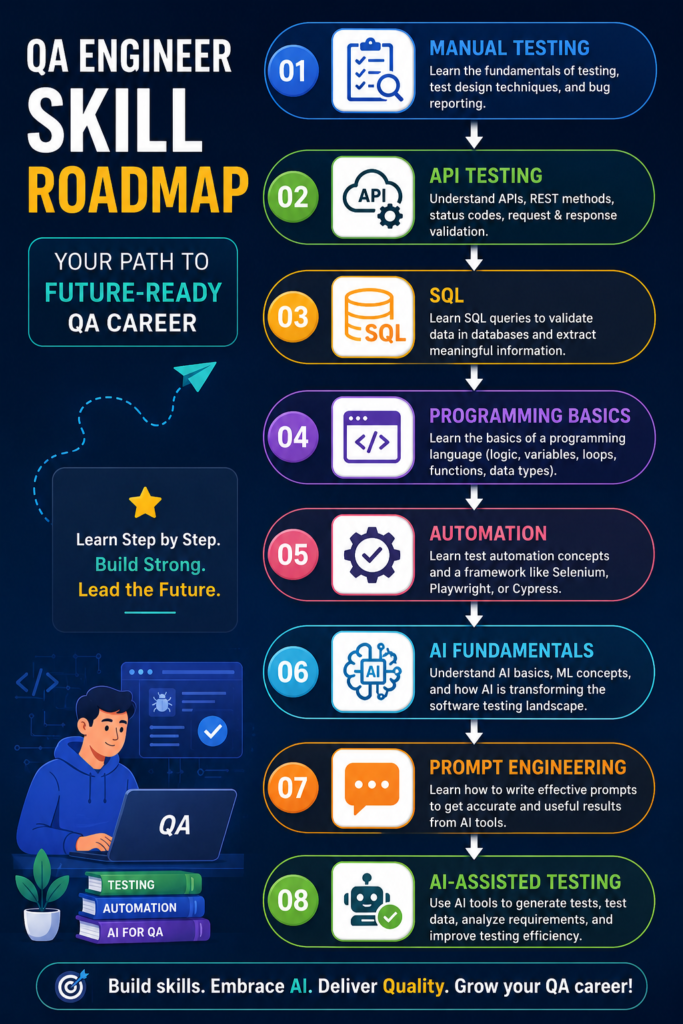
This gives you a much stronger foundation than simply adding “AI” to your resume.
What AI Skills Should Experienced QA Engineers Learn?
If you already have QA experience, focus on using AI to expand your existing capabilities.
Prioritize:
- Prompt engineering
- AI-assisted test design
- AI-assisted automation
- AI-powered defect analysis
- LLM testing
- AI evaluation
- AI security basics
- AI agents
- Quality engineering
Your existing testing experience is an advantage.
You don’t need to start your career again.
You need to add AI to your existing QA skill set.
Common Mistakes QA Engineers Make While Learning AI
1. Learning every AI tool
The tools change quickly.
Focus on concepts and practical workflows.
2. Trusting AI blindly
AI can generate incorrect information.
Validate important outputs.
3. Copying AI-generated automation
Understand the code before using it.
4. Ignoring manual testing
AI doesn’t eliminate the need for testing fundamentals.
5. Ignoring data privacy
Never expose sensitive company or customer information without authorization.
6. Chasing certificates without projects
A certificate can demonstrate learning.
A practical project demonstrates application.
Build something.
Will AI Replace QA Engineers?
This is probably the biggest question.
AI will automate some QA activities.
But QA isn’t simply:
Execute test case → Pass/Fail.
QA professionals need to understand:
- Business requirements
- User behavior
- Risk
- Technical dependencies
- Failure impact
- Security
- Usability
- Quality
Imagine AI generates 500 test scenarios.
Someone still needs to answer:
Which 50 are the highest risk?
That decision requires testing judgment.
That’s why the future is more likely to be:
AI + QA
rather than:
AI vs QA
The Future QA Engineer in 2026
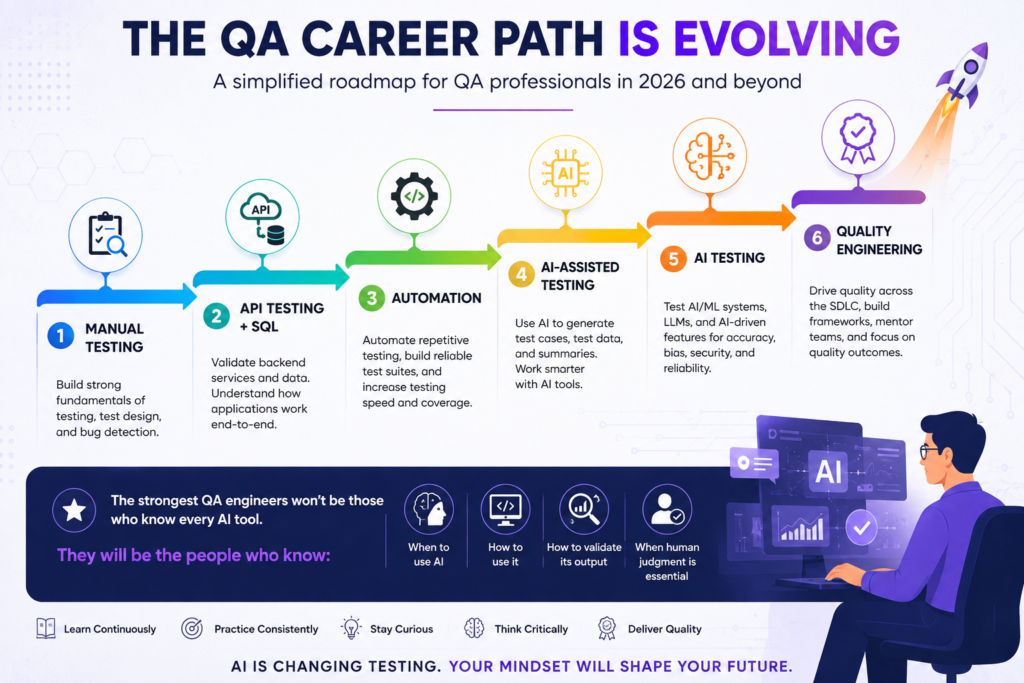
Frequently Asked Questions
What AI skills should QA engineers learn in 2026?
QA engineers should learn prompt engineering, AI-assisted testing, AI automation, AI coding assistance, test-data generation, LLM testing, AI security, AI evaluation, and basic AI/ML concepts.
Will AI replace manual testers?
AI can automate repetitive testing activities, but exploratory testing, risk analysis, business understanding, usability evaluation, and quality decisions still require human judgment.
Does a QA engineer need to learn machine learning?
Not every QA engineer needs advanced ML knowledge. Basic ML concepts become more important if you want to specialize in testing AI-based systems.
Is prompt engineering useful for testers?
Yes. Prompt engineering can help QA engineers generate scenarios, analyze requirements, create test data, review defects, write automation drafts, and create documentation.
What is AI-assisted testing?
AI-assisted testing means using AI to support activities such as test design, test-data generation, automation, defect analysis, and documentation.
What is AI testing?
AI testing means testing software that uses AI or machine-learning technology. This can involve testing model behavior, data quality, accuracy, robustness, hallucinations, security, and other AI-specific characteristics.
Should freshers learn AI before automation?
Generally, build your testing, API, SQL, programming, and automation fundamentals first. Then add AI skills.
Final Takeaway
AI is changing software testing.
But the solution isn’t to abandon traditional QA skills.
Instead:
Strengthen your testing fundamentals.
Then learn:
AI fundamentals → Prompt Engineering → AI-Assisted Testing → Automation → LLM Testing → AI Security → Quality Engineering
Use AI to reduce repetitive work.
Use your QA knowledge to challenge AI-generated results.
Use automation to increase speed.
And use critical thinking to identify risks that tools may miss.
The QA engineer of 2026 doesn’t need to compete with AI.
The QA engineer needs to learn how to work effectively with it.
AI can generate possibilities.
QA engineers decide what matters.
That is the mindset that can help QA professionals stay relevant as software testing continues to evolve.
QA Engineers: Which AI skill are you learning in 2026?
1. Prompt Engineering
2. AI-Assisted Automation
3. AI/LLM Testing
4. AI Security Testing
5. AI Evaluation
Comment your choice below.
I’d love to know what the QA community is focusing on this year.