Your manager asks for an update.
- 1. You’re New
- 2. Something Went Wrong Before
- 3. The Manager Is Under Pressure
- 4. Lack of Trust
- 5. Control Is Their Management Style
- 🚩 1. Constant status updates
- 🚩 2. Every small decision needs approval
- 🚩 3. Your work is repeatedly checked
- 🚩 4. Your manager focuses on activity instead of results
- 🚩 5. You’re given responsibility without authority
- 🚩 6. Your manager changes your approach constantly
- 🚩 7. You feel afraid to make normal decisions
- QA Status Update
- Simple rule:
- When you receive a task:
- Accountability says:
- Micromanagement says:
- ❌ Don’t deliberately slow down
- ❌ Don’t ignore messages
- ❌ Don’t complain to everyone
- ❌ Don’t hide mistakes
- ❌ Don’t send angry messages
- ❌ Don’t resign immediately
- C.L.E.A.R.
- C — Clarify
- L — Lead with communication
- E — Establish trust
- A — Ask for ownership
- R — Raise concerns professionally
- What is micromanagement in IT?
- How do I deal with a micromanaging manager?
- Is asking for daily updates micromanagement?
- How should a fresher deal with micromanagement?
- Should I tell my manager that they are micromanaging me?
- Should I complain to HR about micromanagement?
- Can micromanagement affect career growth?
- Should I leave a job because of a micromanaging manager?
You send one.
Ten minutes later:
“What are you working on now?”
You explain.
Then:
“Why are you doing it that way?”
You explain again.
A little later:
“Send me the test cases before you execute them.”
And the next morning:
“Why did this take so long?”
Sound familiar?
If yes, you may not simply have a “strict manager.”
You may be experiencing micromanagement in IT.
And here’s the interesting part:
Not every manager who closely monitors employees is a micromanager.
Sometimes there is a genuine project problem.
Sometimes you’re new to the team.
Sometimes the manager has lost trust after a previous mistake.
And sometimes…
the manager simply doesn’t know how to let go.
So what should you do?
Should you confront your manager?
Should you stay quiet?
Should you immediately start looking for another job?
Not necessarily.
There are smarter ways to handle the situation.
What Is Micromanagement?
Micromanagement happens when a manager becomes too involved in an employee’s day-to-day work, especially in decisions and activities that the employee should reasonably be able to handle independently.
For example, imagine you’re a QA engineer.
Your manager says:
“Please complete regression testing by Friday and let me know if you find any critical issues.”
That’s normal management.
But imagine the manager says:
“Which test case are you running?”
“Why that one?”
“Send me a screenshot.”
“Why did you spend 15 minutes on this?”
“Don’t close the defect until I approve it.”
“Tell me before you start the next module.”
That’s a different situation.
The issue isn’t one question.
It’s the constant need to control every small step.
Why Do Managers Micromanage?
Before blaming your manager, ask an important question:
Why is this happening?
There can be several reasons.
1. You’re New
If you recently joined the company or team, your manager may want closer visibility.
That’s not necessarily bad.
The real question is:
Does the monitoring reduce as you prove yourself?
If yes, it may simply be a trust-building phase.
2. Something Went Wrong Before
Suppose a critical production bug was released.
Your manager was questioned by senior leadership.
After that, they started checking everything.
Their thinking may be:
“If I personally check everything, nothing will go wrong.”
Unfortunately, excessive control can create another problem.
Employees stop taking ownership.
3. The Manager Is Under Pressure
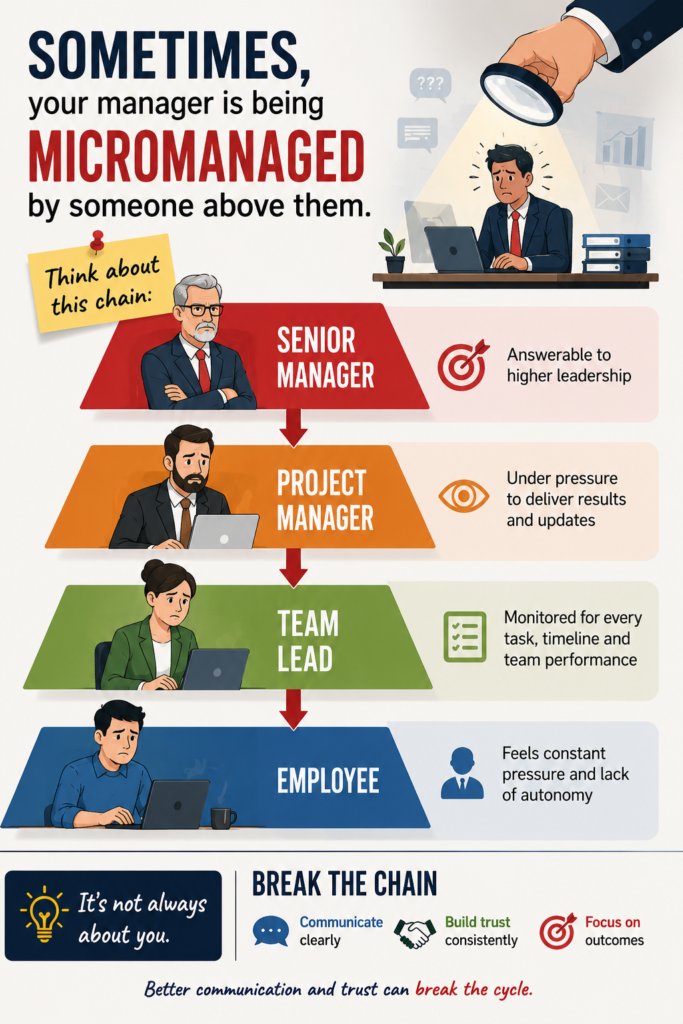
If everyone above your manager is demanding constant status updates, that pressure can travel down the organization.
4. Lack of Trust
Sometimes the simplest explanation is the correct one.
The manager doesn’t trust the employee yet.
This doesn’t necessarily mean you are doing something wrong.
Trust can take time, especially when you’re new.
5. Control Is Their Management Style
Some managers genuinely believe:
“If I don’t monitor my team, work won’t happen.”
That’s when micromanagement can become a long-term workplace problem.
7 Signs of Micromanagement in IT
One difficult conversation doesn’t automatically mean you’re being micromanaged.
Look for a pattern.
🚩 1. Constant status updates
You’re asked what you’re doing every few hours.
🚩 2. Every small decision needs approval
Even routine decisions require permission.
🚩 3. Your work is repeatedly checked
Even after you’ve demonstrated that you can do it correctly.
🚩 4. Your manager focuses on activity instead of results
For example:
“Why were you online for only 8 hours?”
instead of:
“Was the task completed successfully?”
🚩 5. You’re given responsibility without authority
You’re accountable for the result but aren’t allowed to make reasonable decisions.
🚩 6. Your manager changes your approach constantly
Even when your approach is producing the expected outcome.
🚩 7. You feel afraid to make normal decisions
This is perhaps the biggest warning sign.
You start thinking:
“If I make one decision without asking, I’ll get questioned.”
That’s not healthy ownership.
Micromanagement vs Good Management
This difference is important.
| Good Management | Micromanagement |
|---|---|
| Sets expectations | Controls every step |
| Defines deadlines | Constantly asks for updates |
| Provides support | Makes every decision |
| Reviews important work | Reviews everything |
| Focuses on outcomes | Focuses on every activity |
| Builds trust | Creates dependency |
| Gives employees ownership | Takes ownership away |
A good manager doesn’t disappear.
They provide direction, support and accountability while giving employees reasonable freedom to do their jobs.
So, How Should Employees Handle Micromanagement?
This is where most people make a mistake.
They immediately think:
“My manager is micromanaging me. I need to confront them.”
Slow down.
Your first goal shouldn’t be to win an argument.
Your goal should be to change the working relationship.
Here’s how.
1. Start With Proactive Communication
This is one of the simplest things you can try.
Don’t wait for your manager to ask:
“What’s the status?”
Send the update yourself.
For example:
QA Status Update
✅ Login testing completed
✅ 32 scenarios executed
🐞 2 medium-priority defects identified
🔄 Payment regression in progress
⚠️ Waiting for API fix
📅 Expected completion: Thursday
Now your manager knows:
- What you’ve completed
- What you’re doing
- What’s blocking you
- What’s coming next
You may find that the number of interruptions decreases.
Simple rule:
Give visibility before they ask for it.
2. Agree on an Update Schedule
If your manager asks for updates constantly, don’t simply complain.
Suggest a better process.
You could say:
“Would it be okay if I send you a consolidated update at the end of the day and immediately escalate any critical blockers?”
This does two things:
You provide visibility.
You protect focused working time.
That’s a much stronger approach than:
“Please stop checking on me.”
3. Build Trust Through Consistency
Trust doesn’t usually come from one conversation.
It comes from repeated behavior.
Do what you say you’ll do.
If you commit to Friday:
Deliver by Friday.
If you’re blocked:
Tell them early.
If you make a mistake:
Own it.
If you don’t know something:
Ask.
Over time, your manager gets evidence that you can handle responsibility.
And evidence is often more powerful than arguments.
4. Don’t Hide Problems
This is especially important in IT.
Sometimes employees hide problems because they’re afraid their manager will start monitoring them even more.
That’s risky.
Suppose you’re testing a payment feature and discover a critical defect.
Don’t wait three days hoping to solve it silently.
Say:
“I’ve identified a blocker in the payment flow. I’m investigating the API and database behavior now. I’ll share an update after the initial analysis.”
Notice what you’re communicating:
Problem + Ownership + Action + Next update
That’s professional communication.
5. Ask for Ownership
This can be surprisingly effective.
Instead of asking:
“What should I do next?”
try:
“Can I take ownership of the regression testing for this release and provide you with the final status, risks, and blockers?”
Now you’re asking for responsibility, not just freedom.
If your manager agrees, you have an opportunity to demonstrate that you can work independently.
6. Talk About the Impact, Not the Personality
Avoid saying:
❌ “You’re micromanaging me.”
That can immediately make the conversation defensive.
Instead:
“I’ve noticed that frequent status discussions are sometimes interrupting the detailed testing work. Could we consolidate routine updates while I immediately escalate anything critical?”
This approach focuses on:
Behavior → Impact → Solution
rather than:
Person → Blame
That’s a much safer workplace conversation.
7. Choose the Right Moment
Don’t raise this issue during:
❌ Production incidents
❌ Major releases
❌ Customer escalations
❌ High-pressure meetings
Choose a calm time.
You could start with:
“I’d like to discuss how we can make our working process more efficient.”
Then explain the situation.
Keep the conversation professional and specific.
What If You’re a Fresher?
For freshers, this situation can feel even more difficult.
You may think:
“If I say something, they’ll think I’m not capable.”
So you say nothing.
Instead, focus on building credibility.
When you receive a task:
Clarify
“Could you confirm the expected outcome?”
Confirm the deadline
“I’ll complete this by Thursday.”
Give progress
“Functional testing is complete. I’m working on negative scenarios now.”
Escalate blockers
“I’m blocked because the test environment is unavailable.”
Close the task
“Testing is complete and I’ve shared the report.”
This communication style shows maturity even when you’re new.
What If You’re an Experienced QA Engineer?
Experienced employees face a different problem.
You may think:
“I’ve been doing this for years. Why do I need approval for everything?”
The answer isn’t to become confrontational.
Show your manager that you think beyond task execution.
Instead of:
“I tested 200 test cases.”
say:
“200 scenarios were executed. Two high-severity issues remain open, payment testing is blocked, and the checkout regression is complete.”
Now you’re communicating:
Testing + Risk + Business Impact
That makes it easier for leadership to trust your judgment.
Don’t Confuse Accountability With Micromanagement
This is one of the most important points in this article.
Your manager asking:
“What’s the status?”
isn’t automatically micromanagement.
Your manager asking:
“What are the risks?”
isn’t micromanagement.
Your manager reviewing a critical production change isn’t micromanagement.
Accountability says:
“You own the result. Keep me informed.”
Micromanagement says:
“You own the result, but I want to control how you achieve it.”
That’s the difference.
What Should You NOT Do?
When dealing with a micromanaging manager, avoid these reactions.
❌ Don’t deliberately slow down
It can hurt your own reputation.
❌ Don’t ignore messages
That may increase the manager’s concern.
❌ Don’t complain to everyone
Workplace gossip can easily come back to you.
❌ Don’t hide mistakes
Transparency builds trust.
❌ Don’t send angry messages
Written messages can easily be misunderstood.
❌ Don’t resign immediately
One difficult manager doesn’t automatically mean you need to leave.
First understand whether the situation can be improved.
When Should You Escalate the Problem?
If you’ve already tried:
- Clear communication
- Proactive updates
- Building trust
- Requesting ownership
- Setting reasonable boundaries
and nothing changes, you may need to escalate.
Talk to an appropriate:
- Senior manager
- Mentor
- HR representative
- Trusted organizational leader
But keep the conversation factual.
Don’t say:
“My manager is terrible.”
Instead say:
“I’ve tried several ways to improve the working arrangement, but the level of monitoring continues to affect my ability to complete focused work efficiently.”
Specific examples are much more useful than general complaints.
When Should You Consider Leaving?
Sometimes the problem isn’t temporary.
You’ve communicated.
You’ve delivered.
You’ve built trust.
You’ve tried to improve the relationship.
But the environment remains unhealthy.
Consider looking elsewhere if you consistently experience:
- No meaningful autonomy
- Unfair treatment
- Constant unreasonable monitoring
- No career growth
- Persistent disrespect
- Unreasonable performance pressure
- A workplace culture that doesn’t support employees
But don’t make a career decision because of one bad week.
Look for a pattern.
And if you decide to leave, make it a planned career move, not an emotional reaction.
A Simple 5-Step Framework to Handle Micromanagement
Remember this:
C.L.E.A.R.
C — Clarify
Understand what your manager expects.
L — Lead with communication
Provide proactive updates.
E — Establish trust
Deliver consistently.
A — Ask for ownership
Take responsibility for outcomes.
R — Raise concerns professionally
If the situation doesn’t improve, discuss it through the right channel.
This framework can work for freshers, QA engineers, developers, analysts, and other IT professionals.
One Question Every Employee Should Ask
If you’re dealing with micromanagement, ask yourself:
“What can I do to make my manager feel confident enough to step back?”
Maybe it’s:
- Better communication
- Better documentation
- Earlier escalation
- More consistent delivery
- Clearer status updates
- Taking ownership
Sometimes changing your communication style can change the entire relationship.
But if you’ve done all of that and the manager still insists on controlling every detail, the problem may no longer be your performance.
It may be the management culture.
The Bigger Problem: Workplace Culture
Micromanagement doesn’t always come from one individual.
Sometimes it comes from the organization itself.
If leaders reward:
“Always be online.”
instead of:
“Deliver quality work.”
employees may feel constantly monitored.
If managers are judged by:
- Number of hours
- Number of updates
- Task counts
- Immediate responses
instead of:
- Quality
- Outcomes
- Customer impact
- Risk reduction
- Team growth
micromanagement can become normal.
That’s why employees should evaluate not only their manager but also the overall workplace culture.
The Best Managers Know When to Step Back
A good manager doesn’t need to know every action their employee takes.
They need to know:
What is the goal?
What is the status?
What are the risks?
What support is needed?
Will the outcome be delivered?
That’s enough in many situations.
The employee gets room to work.
The manager gets visibility.
The team gets ownership.
And everyone wins.
Final Takeaway
Micromanagement in IT can be frustrating — but your first response doesn’t have to be confrontation.
Start by understanding why it is happening.
Then:
Communicate proactively.
Build trust.
Escalate problems early.
Ask for ownership.
Set professional boundaries.
And if nothing changes, use the appropriate escalation process or consider whether the workplace is still right for your career.
Remember:
You don’t need a manager who never checks on you.
You need a manager who trusts you enough to let you work.
And you don’t need to prove your independence by refusing feedback.
You prove it by taking ownership and delivering results.
Frequently Asked Questions
What is micromanagement in IT?
Micromanagement in IT occurs when a manager excessively controls or monitors an employee’s daily work, including routine decisions that the employee should reasonably be able to handle independently.
How do I deal with a micromanaging manager?
Start with proactive communication, clarify expectations, provide regular updates, build trust through consistent delivery, and ask for ownership of complete tasks or outcomes.
Is asking for daily updates micromanagement?
Not necessarily. Daily updates can be reasonable for some projects. It becomes problematic when monitoring is excessive, focuses on minor details, or prevents employees from working independently.
How should a fresher deal with micromanagement?
A fresher should focus on understanding expectations, communicating progress, meeting deadlines, escalating blockers early, and gradually demonstrating ownership.
Should I tell my manager that they are micromanaging me?
Usually, avoid using the label directly. Instead, explain the behavior and its impact and suggest a practical solution.
Should I complain to HR about micromanagement?
Not every case requires HR involvement. Try professional communication first when appropriate. If the situation involves serious workplace misconduct or doesn’t improve despite reasonable attempts, follow your organization’s escalation process.
Can micromanagement affect career growth?
Yes. Excessive control can reduce opportunities to make decisions and demonstrate ownership. Over time, this can affect professional development and job satisfaction.
Should I leave a job because of a micromanaging manager?
Not immediately. First determine whether communication, trust-building, and clearer expectations can improve the relationship. If the problem is persistent and affects your growth or working environment, consider other opportunities.
Good management gives you direction. Micromanagement controls every step.
Have you experienced the difference? What helped you handle it professionally?