19. Common Mistakes Manual Testers Make
Mistake 1: Trying to Learn Everything
You don’t need five automation tools.
- 19. Common Mistakes Manual Testers Make
- Mistake 1: Trying to Learn Everything
- Mistake 2: Focusing Only on Coding
- Mistake 3: Watching Courses Without Practicing
- Mistake 4: Comparing Yourself With Developers
- Mistake 5: Being Afraid of Errors
- Manual Tester → Automation Tester
- Your Manual Testing Experience Is Your Foundation
- Final Thought :
- FAQ for Manual Tester:
- Other Internal Links:
Start with one.
Mistake 2: Focusing Only on Coding
Automation is not just coding.
You still need:
Testing knowledge + Automation knowledge
Both are important.
Mistake 3: Watching Courses Without Practicing
Watching 50 hours of tutorials won’t make you an automation tester.
Use this rule:
Learn → Practice → Build → Repeat
Mistake 4: Comparing Yourself With Developers
You don’t need to compete with developers.
Your goal is to become a strong QA engineer who can automate tests.
Mistake 5: Being Afraid of Errors
Your first automation script may fail.
Then the second one may fail.
That’s normal.
Errors are part of learning automation.
Instead of thinking:
“I cannot code.”
Think:
“I haven’t learned this concept yet.”
There is a big difference.
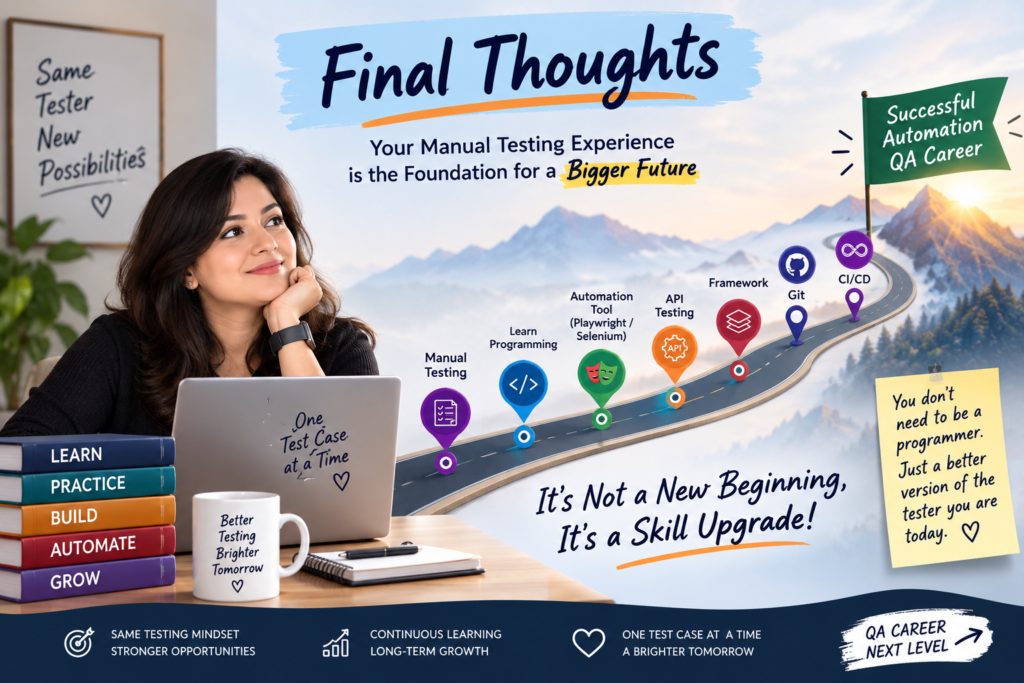
Manual Tester → Automation Tester
Think about your journey like this:
Manual Testing Experience
          ↓
Testing Fundamentals
          ↓
Programming Basics
          ↓
Automation Tool
          ↓
Automate Existing Test Cases
          ↓
Framework Concepts
          ↓
API Testing
          ↓
Git & GitHub
          ↓
CI/CD
          ↓
Automation QA Engineer
You don’t have to throw away your past experience.
You build on it.
Your Manual Testing Experience Is Your Foundation
If you have spent years doing manual testing, don’t think:
“I am starting from zero.”
You are not.
You already understand what makes a good test.
You understand:
- Requirements
- User behavior
- Edge cases
- Negative scenarios
- Regression
- Bugs
- Business impact
- Expected results
Now you’re learning how to make a computer execute some of those tests for you.
That’s a skill upgrade, not a career restart.
Final Thought :
FAQ for Manual Tester:
1. Can a manual tester become an automation tester?
Yes. Manual testing experience provides a strong foundation because automation still requires knowledge of test cases, requirements, regression testing, negative scenarios, and expected results.
2. How long does it take to move from manual testing to automation?
The time varies by person, but a manual tester who consistently practices can start automating simple test cases within a few weeks.
3. Which automation tool is best for manual testers?
There is no single best tool for everyone. Playwright, Selenium, and other tools can be good choices depending on the technology and requirements of the organization.
4. Do I need strong coding skills for automation testing?
You need programming fundamentals, but you don’t need to become an expert software developer. Start with basic programming concepts and gradually build your automation skills.
5. Is manual testing experience useful for automation testing?
Absolutely. Manual testing experience helps you understand what to automate, how to design test scenarios, what to validate, and how to analyze failures.
Other Internal Links:
- Chatbot Testing: 7 Powerful Ways to Test Chatbots as a QA Engineer
- AI Playwright Automation: 10 Simple Ways AI Helps You Write Tests
- AI Agent Testing: 7 New Opportunities for QA Engineers
- 10 Playwright Mistakes Beginners Make — And How to Avoid Them
- 50 Playwright Interview Questions: Powerful Answers to Boost Your QA Career
- 50 Powerful Manual Testing Interview Questions to Ace Your QA Interview
- Real-Time Production Bug Interview Questions: 15+ Scenarios Every QA Should Know
- 10 QA Resume Mistakes That Reduce Shortlisting in 2026
- How to Handle Unrealistic Testing Deadlines: 7 Smart Strategies for QA Engineers
- Micromanagement in IT: 7 Smart Ways to Handle It Professionally
- AI Skills for QA Engineers in 2026: Must-Know Skills & Roadmap
- Manual Testing in 2026: The Ultimate Guide Dying or Evolving?