19. A Practical AI Workflow for QA Engineers
AI for QA Engineers can follow a simple workflow to use AI efficiently without losing their testing judgment.
Here is a simple workflow you can start using.
Step 1 — Understand the requirement yourself
Read the requirement carefully.
Identify:
- Business rules
- User actions
- Expected behavior
- Dependencies
- Risks
Step 2 — Create your own initial scenarios
Before using AI, write down what you think should be tested.
Step 3 — Ask AI for additional ideas
Ask AI to identify:
- Missing scenarios
- Edge cases
- Negative scenarios
- Boundary conditions
- Risk areas
Step 4 — Compare
Compare your thinking with AI’s suggestions.
Step 5 — Validate
Check every AI suggestion against the actual requirements.
Step 6 — Execute testing
Perform the testing yourself.
Step 7 — Use AI for documentation
AI can help improve:
- Test cases
- Bug reports
- Test summaries
- Release notes
- Test documentation
Step 8 — Learn from the process
Ask yourself:
“What did AI identify that I missed?”
This question can make you a better tester.
20. A Simple Framework: THINK → ASK → VERIFY → LEARN
If you remember only one framework from this article, remember this:
🧠 THINK
First use your own testing knowledge.
What would you test?
What could fail?
What are the risks?
🤖 ASK
Now use AI for assistance.
Ask for:
- Additional scenarios
- Alternative approaches
- Explanations
- Suggestions
- Code examples
🔍 VERIFY
Never assume AI is correct.
Check the output against:
- Requirements
- Application behavior
- Documentation
- Actual test results
- Team standards
📚 LEARN
Understand what AI suggested.
Don’t just copy.
Ask:
“Why?”
“How?”
“When should I use this?”
That’s how AI helps you grow instead of making you dependent.
21. What Skills Should QA Engineers Continue Building?
Even in an AI-driven testing world, QA engineers should continue developing fundamental skills.
Testing Fundamentals
Understand:
- SDLC
- STLC
- Test levels
- Test types
- Defect lifecycle
- Test design techniques
- Risk-based testing
- Regression testing
- Exploratory testing
Technical Skills
Build knowledge in:
- API testing
- SQL
- Git
- Browser DevTools
- Automation
- Playwright/Selenium
- JavaScript/TypeScript/Python
- CI/CD
Soft Skills
Don’t ignore:
- Communication
- Requirement analysis
- Critical thinking
- Problem solving
- Collaboration
- Asking good questions
AI Skills
Learn:
- Prompt engineering
- AI-assisted testing
- AI-generated test cases
- AI-assisted automation
- AI-based test analysis
- AI limitations
- Responsible AI usage
The goal isn’t to become someone who only knows AI tools.
The goal is to become a strong QA engineer who knows how to use AI effectively.
22. The Future QA Engineer
The future QA engineer won’t simply be:
Manual Tester
or
Automation Tester
The role is moving toward something broader.
A QA engineer may need to understand:
Testing + Automation + APIs + CI/CD + AI + Product Knowledge
But the foundation remains the same.
Think like a tester.
AI can help you execute faster.
Automation can help you execute repeatedly.
Tools can help you collect information.
But the QA engineer must still decide:
What should we test, why should we test it, and what does quality actually mean for the user?
Final Thoughts
AI is not the enemy of QA engineers.
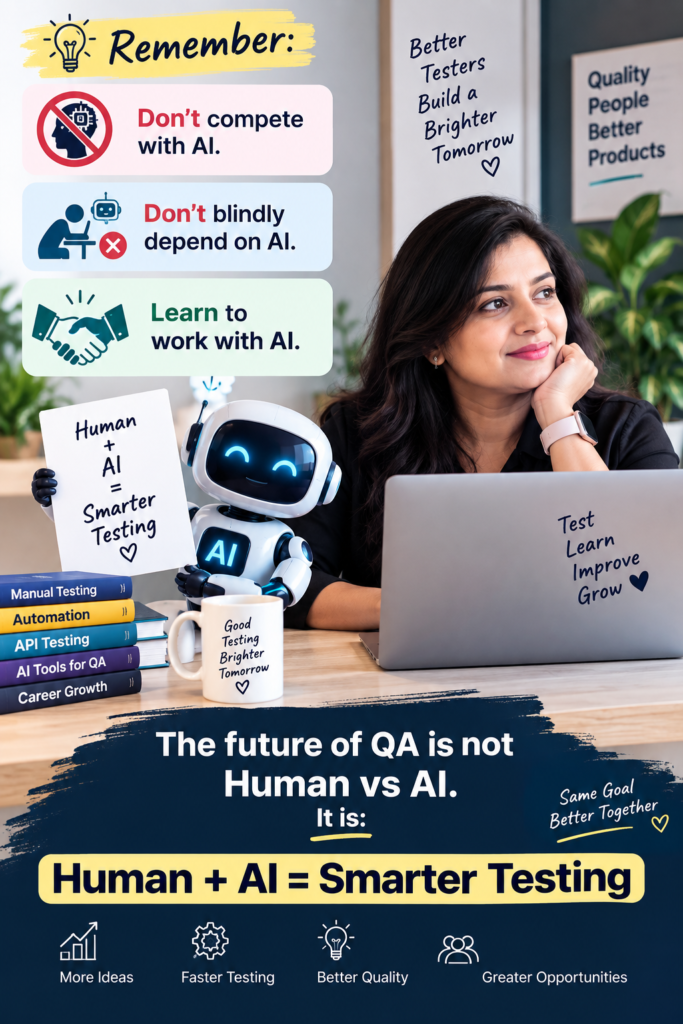
The future of AI for QA Engineers is not about replacing human testers; it is about combining human testing skills with AI assistance.
For AI for QA Engineers, the goal is not to use AI for every task, but to use it where it genuinely improves testing.
In fact, AI can become one of the most powerful assistants in a QA engineer’s toolkit.
It can help you:
- Generate ideas
- Analyze requirements
- Create test data
- Improve documentation
- Understand errors
- Write automation code
- Review test scenarios
- Save repetitive effort
But there is one condition.
Don’t outsource your thinking.
Use AI to challenge your ideas.
Use it to find gaps.
Use it to learn.
Use it to work faster.
But always keep the final judgment with the QA engineer.
The strongest QA engineers of the future will not be those who use AI for everything.
They will be those who know when to use AI, when not to use AI, and how to verify what AI produces.
AI should make you a better QA engineer—not a dependent QA engineer.
Start Today
Try this simple exercise.
Pick one feature from your current project or a practice application.
- Write 10 test scenarios without AI.
- Ask AI for additional scenarios.
- Compare both lists.
- Identify what you missed.
- Validate AI’s suggestions.
- Update your final test suite.
- Learn from the gaps.
Do this regularly.
You won’t just become better at using AI.
You’ll become a better tester.
Other Internal Links:
- Manual Testing to Automation Testing: 7 Proven Steps to Boost Your QA Career
- Chatbot Testing: 7 Powerful Ways to Test Chatbots as a QA Engineer
- AI Playwright Automation: 10 Simple Ways AI Helps You Write Tests
- AI Agent Testing: 7 New Opportunities for QA Engineers
- 10 Playwright Mistakes Beginners Make — And How to Avoid Them
- 50 Playwright Interview Questions: Powerful Answers to Boost Your QA Career
- 50 Powerful Manual Testing Interview Questions to Ace Your QA Interview
- Real-Time Production Bug Interview Questions: 15+ Scenarios Every QA Should Know
- 10 QA Resume Mistakes That Reduce Shortlisting in 2026
- How to Handle Unrealistic Testing Deadlines: 7 Smart Strategies for QA Engineers
- Micromanagement in IT: 7 Smart Ways to Handle It Professionally
- AI Skills for QA Engineers in 2026: Must-Know Skills & Roadmap
- Manual Testing in 2026: The Ultimate Guide Dying or Evolving?