Benefits of AI Tools for QA Engineers
Using AI thoughtfully can provide several benefits.
- Benefits of AI Tools for QA Engineers
- Limitations and Risks of AI in Software Testing
- Frequently Asked Questions (FAQs)
- 1. Which AI tool is best for QA engineers?
- 2. Can manual testers use AI tools without coding?
- 3. Will AI replace QA engineers?
- 4. Is AI-generated automation code always correct?
- 5. Which AI skills should a beginner QA engineer learn first?
- 6. Are AI testing tools free?
- Conclusion
- Other Internal Links:
1. Faster test design: AI can suggest initial test cases and edge scenarios, reducing the time needed to create a first draft.
2. Easier coding practice: Beginners can learn automation concepts through examples and explanations.
3. Better brainstorming: AI can suggest scenarios that a tester may want to investigate further.
4. Support for debugging: AI can help explain errors and organize possible causes.
5. Improved documentation: Test cases, bug reports, test summaries, and release notes can be drafted more efficiently.
6. More time for critical thinking: Reducing repetitive work can give QA engineers more time to investigate complex business scenarios and risks.
These benefits depend on the quality of the input, the tool’s capabilities, and the tester’s review process.
Limitations and Risks of AI in Software Testing
AI is helpful, but it is not perfect.
Incorrect test cases: AI may misunderstand a requirement or generate scenarios that do not apply to the application.
Incorrect automation code: Generated scripts may contain invalid locators, weak assertions, or outdated syntax.
Missed business rules: An AI assistant cannot reliably test requirements it has not been given.
Security and privacy concerns: Sharing confidential code, customer data, passwords, API keys, or production information with an unapproved AI tool can create security risks.
False confidence: A test passing does not prove that the application is completely free of defects.
To reduce these risks, use approved tools, provide appropriate context, review generated results, execute the tests, and retain human oversight.
Frequently Asked Questions (FAQs)
1. Which AI tool is best for QA engineers?
There is no single best tool for every testing task. ChatGPT is useful for test design and explanations, GitHub Copilot assists with coding, Postman AI features support API workflows, and Applitools focuses on visual testing.
2. Can manual testers use AI tools without coding?
Yes. Manual testers can use AI to brainstorm test scenarios, prepare test data, review requirements, and draft bug reports. Basic programming knowledge becomes more important when working with automation.
3. Will AI replace QA engineers?
AI may automate parts of repetitive testing work, but quality assurance also requires business understanding, risk analysis, exploratory testing, and human judgment. Learning to use AI effectively can help QA professionals adapt to changing expectations.
4. Is AI-generated automation code always correct?
No. Generated code may contain mistakes or incomplete assertions. Review the script, check the locators, execute the test, and verify that it validates the intended business behavior.
5. Which AI skills should a beginner QA engineer learn first?
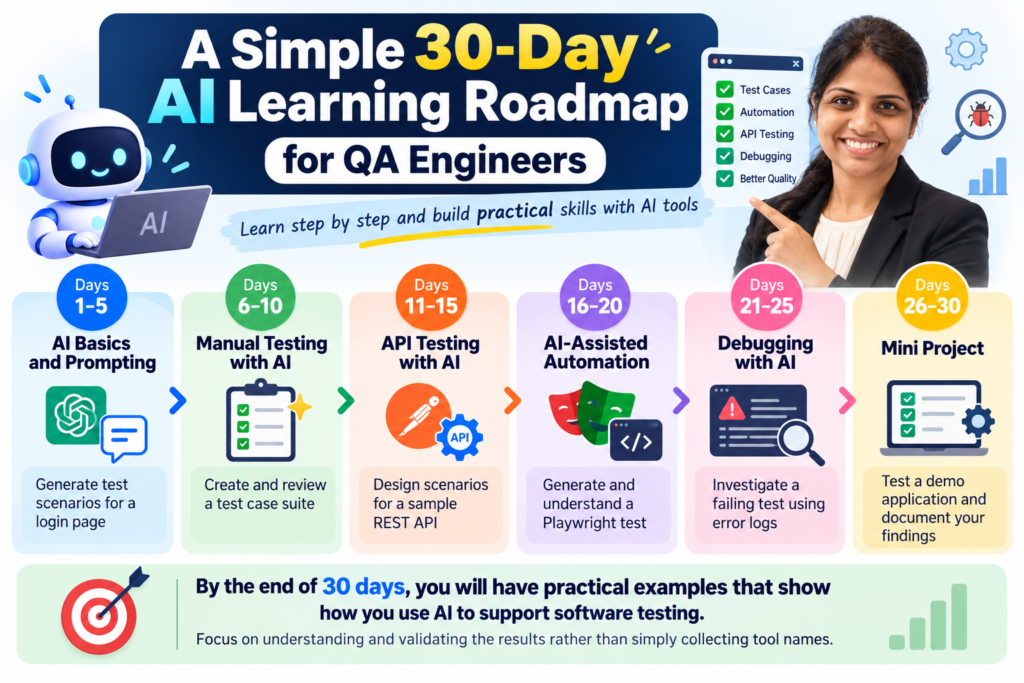
Start with effective prompting, test case generation, error analysis, and responsible use of AI. Then learn API testing and an automation framework such as Playwright with TypeScript.
6. Are AI testing tools free?
Some tools offer free access, trials, or limited features, while others require paid subscriptions. Check the official product documentation and current pricing before choosing a tool.
Conclusion
AI is becoming a useful assistant in modern software testing. From generating test scenarios to supporting automation and identifying visual regressions, different tools can help QA engineers work more efficiently.
However, knowing how to use an AI tool is only part of the skill. A strong QA engineer must also understand requirements, validate test results, investigate defects, and protect sensitive information.
My recommendation: Start with ChatGPT for test design, learn GitHub Copilot or another approved coding assistant for automation, and explore Postman AI features if API testing is part of your role. Once you understand these basics, consider specialized tools such as Playwright Test Agents, Katalon, mabl, or Applitools.
The goal is not to use every AI tool available. The goal is to choose the right tool for the right testing problem and use it responsibly.
Keep learning, keep testing, and keep improving your QA skills.