Have you ever tested a chatbot and wondered: “How do I know whether this answer is correct?”
Traditional software testing is usually straightforward.
You enter a username and password → click Login → verify the result.
But chatbot testing is different.
A chatbot may give different responses to the same question. It may understand one sentence but misunderstand another. It may provide a technically correct answer that is still not useful to the user.
This creates a new challenge for QA Engineers.
As AI-powered chatbots become common in websites, mobile applications, customer support systems, banking applications, e-commerce platforms, and internal business tools, QA Engineers need to understand how to test them effectively.
In this blog, we will learn:
- What chatbot testing is
- Why chatbot testing is different from traditional testing
- What a QA Engineer should test in a chatbot
- Functional testing of chatbots
- Conversation testing
- Negative testing
- Context testing
- Accuracy testing
- Security testing
- Performance testing
- UI testing
- How to write chatbot test cases
- Real-world chatbot testing examples
- Common chatbot bugs
- A practical chatbot testing checklist
- Skills QA Engineers need for chatbot testing
Let’s start.
What Is a Chatbot?
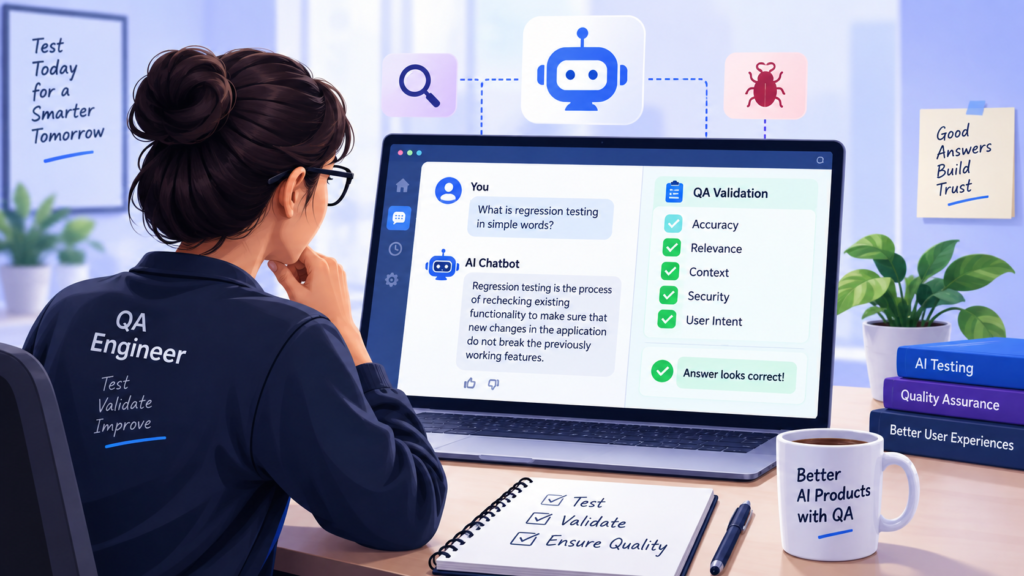
A chatbot is a software application that communicates with users through conversation.
The user enters a question or message, and the chatbot generates a response.
For example:
User:
What is your return policy?
Chatbot:
You can return eligible products within 30 days of delivery.
The chatbot may use:
- Predefined rules
- Natural Language Processing (NLP)
- Machine Learning
- Generative AI
- Large Language Models (LLMs)
- Retrieval-Augmented Generation (RAG)
- APIs
- Databases
Modern AI chatbots can understand natural language and generate responses instead of simply selecting a predefined answer.
That makes chatbot testing more interesting—and more challenging.
Why Is Chatbot Testing Different?
In traditional software testing, we often have an expected result.
For example:
Test:
Enter valid username and password.
Expected result:
User should successfully log in.
But chatbot testing can look like this:
User:
I want to return my order.
The chatbot might respond:
Sure. Please provide your order number.
There can be several acceptable ways for the chatbot to respond.
For example:
Please share your order ID so I can help you with the return.
Both responses may be correct.
Therefore, QA Engineers cannot always validate chatbot responses using simple exact-text comparison.
Instead, we need to evaluate things such as:
- Is the answer relevant?
- Is the answer factually correct?
- Did the chatbot understand the user’s intent?
- Did it maintain context?
- Did it follow business rules?
- Did it avoid harmful or sensitive information?
- Did it provide the correct next step?