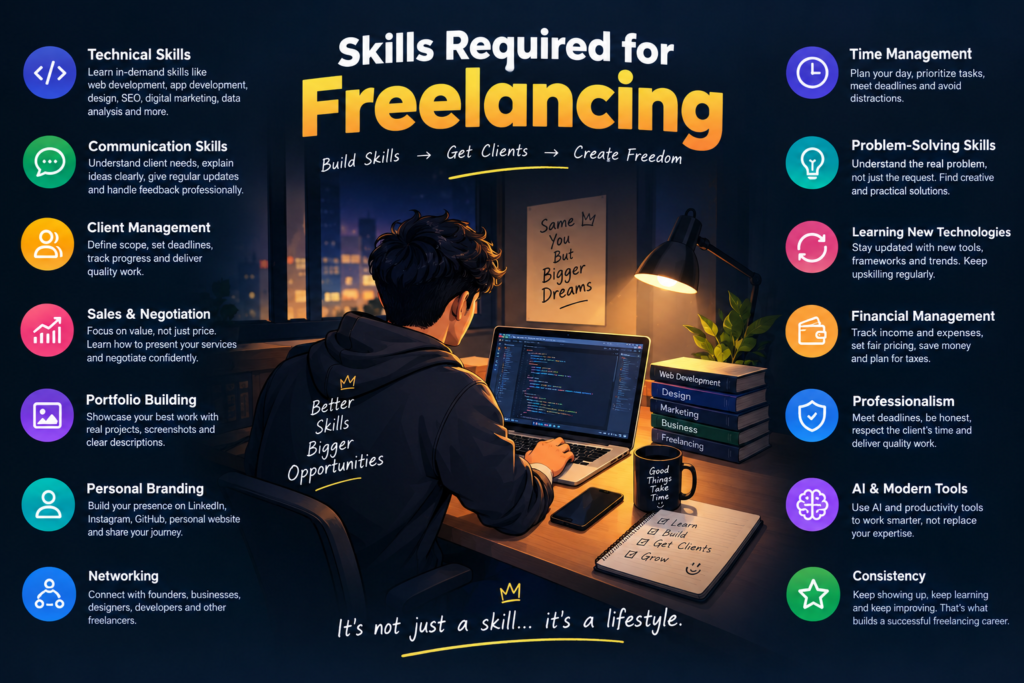
Freelancing has become one of the most popular ways to build a career, earn money, and work with clients from different parts of the world. Whether you are a college student, a working professional, or someone looking to start a side income, freelancing can give you the freedom to choose your projects and work on your own terms.
- 1. Technical Skills
- 2. Communication Skills
- 3. Client Management
- 4. Sales and Negotiation Skills
- 5. Portfolio Building
- 6. Personal Branding
- 7. Networking
- 8. Time Management
- 9. Problem-Solving Skills
- 10. Learning New Technologies
- 11. Financial Management
- 12. Professionalism
- 13. AI and Modern Tools
- 14. The Most Important Skill: Consistency
- Final Thoughts
But freelancing is not just about knowing a technical skill.
To become a successful freelancer, you need a combination of technical skills, communication skills, business skills, and personal discipline.
In this blog, we will discuss the most important skills you need to start and grow your freelancing career.
1. Technical Skills
The first and most important requirement for freelancing is having a skill that people are willing to pay for.
Depending on your field, you can learn skills such as:
- Web development
- App development
- UI/UX design
- Graphic design
- Video editing
- Digital marketing
- SEO
- Content writing
- Social media management
- Data analysis
- Cloud computing
- DevOps
- Software development
For example, if you are a developer, you can specialize in technologies such as Flutter, React, Java, Python, PHP, .NET, SQL, Firebase, Supabase, or cloud technologies.
You don’t need to learn everything.
Start with one strong skill and become good enough to solve real-world problems with it.
2. Communication Skills
You can be an excellent developer or designer, but poor communication can still cost you clients.
Freelancers regularly communicate with clients through:
- Zoom
- Google Meet
- Freelancing platforms
You should be able to clearly understand what the client wants and explain your ideas in simple language.
Good communication includes:
- Asking the right questions
- Giving regular updates
- Explaining technical concepts simply
- Responding professionally
- Handling feedback
- Setting expectations clearly
Remember:
Clients don’t just pay for your skills. They pay for a smooth experience.
3. Client Management
Getting a client is only the beginning.
You also need to know how to manage the project after the client agrees to work with you.
A good freelancer knows how to:
- Understand requirements
- Define project scope
- Set deadlines
- Discuss revisions
- Track progress
- Handle changes
- Deliver the final project
Before starting a project, make sure both sides clearly understand what is included and what is not included.
This can prevent many misunderstandings later.
4. Sales and Negotiation Skills
Freelancing is also a business.
You need to know how to sell your services without sounding desperate.
For example, instead of saying:
“I can build your website for ₹10,000.”
You can explain the value:
“I can build a responsive website that showcases your services, generates leads, and works smoothly on mobile and desktop.”
The second approach focuses on the problem you are solving, not just the price.
You should also learn basic negotiation skills.
Don’t immediately reduce your price whenever a client says your quote is expensive.
Instead, understand the client’s requirements and adjust the project scope if necessary.
5. Portfolio Building
Clients want proof that you can deliver.
That’s why a strong portfolio is extremely important.
Your portfolio should include:
- Your best projects
- Screenshots
- Project descriptions
- Technologies used
- Problems you solved
- Results or outcomes
- Your contact information
If you don’t have clients yet, create your own projects.
For example, a beginner web developer can create:
- Restaurant website
- E-commerce website
- Business landing page
- Portfolio website
- Dashboard application
These projects can demonstrate your capabilities even before you get your first client.
6. Personal Branding
In today’s freelancing market, personal branding can help you stand out.
Create an online presence where potential clients can understand:
Who you are → What you do → What problems you solve → How to contact you
You can build your personal brand through:
- X
- GitHub
- Personal website
- YouTube
- Blogging
Share your projects, knowledge, experiences, and lessons.
You don’t need millions of followers.
You need the right audience.
7. Networking
Many freelancers focus only on freelancing platforms.
But clients can come from anywhere.
Networking can help you connect with:
- Startup founders
- Business owners
- Developers
- Designers
- Marketing agencies
- Entrepreneurs
- Other freelancers
Build genuine relationships instead of directly asking everyone for work.
Sometimes your next client can come through a simple recommendation from someone in your network.
8. Time Management
One of the biggest advantages of freelancing is flexibility.
But flexibility can also become a problem.
Without proper time management, you may end up missing deadlines or working late every day.
Learn how to:
- Plan your day
- Prioritize tasks
- Estimate project timelines
- Set realistic deadlines
- Avoid unnecessary distractions
- Track your working hours
Don’t accept five projects if you can realistically handle only two.
9. Problem-Solving Skills
Clients don’t hire freelancers just to write code or design graphics.
They hire freelancers to solve problems.
A client might say:
“I need a website.”
But the real requirement could be:
“I need more customers to find my business online.”
Understanding the actual problem allows you to provide better solutions.
Strong problem-solving skills also help you deal with unexpected bugs, changing requirements, technical limitations, and project challenges.
10. Learning New Technologies
Technology changes quickly.
A skill that is highly demanded today may become less valuable in the future.
Successful freelancers continuously learn.
For developers, this could mean learning:
- AI tools
- Cloud computing
- DevOps
- APIs
- Databases
- New frameworks
- Automation
- Cybersecurity
You don’t need to chase every trend.
Instead, learn technologies that complement your existing skills and increase the value you can provide to clients.
11. Financial Management
Freelancers don’t always have a fixed monthly income.
That’s why basic financial management is important.
Learn how to:
- Track income
- Track expenses
- Save money
- Set project-based pricing
- Maintain an emergency fund
- Keep records of payments
- Plan for taxes
Don’t treat your entire freelance income as disposable money.
Think like a business owner.
12. Professionalism
Professionalism can turn a one-time client into a repeat client.
Simple things matter:
- Meet deadlines
- Communicate clearly
- Keep promises
- Be honest about your capabilities
- Respect the client’s time
- Provide updates
- Deliver quality work
A freelancer who is easy to work with often gets more opportunities through referrals and repeat projects.
13. AI and Modern Tools
AI has changed the way freelancers work.
Tools powered by AI can help freelancers with:
- Brainstorming
- Research
- Coding assistance
- Content creation
- Design ideas
- Documentation
- Debugging
- Automation
But AI should be treated as a productivity tool, not a replacement for understanding your skill.
If you don’t understand what you are building, blindly depending on AI can create more problems than it solves.
The strongest combination is:
Human expertise + AI productivity.
14. The Most Important Skill: Consistency
You may have excellent technical skills, but freelancing takes time.
You may send 20 proposals and receive no response.
You may contact 50 businesses and get only a few replies.
You may lose a project after spending hours preparing for it.
That’s normal.
Consistency is what separates people who try freelancing from people who actually build a freelancing career.
Keep improving your skills, portfolio, communication, networking, and client acquisition process.
Final Thoughts
Freelancing is not just about learning a programming language, designing websites, or editing videos.
It requires a combination of technical expertise, communication, sales, networking, time management, problem-solving, personal branding, and business skills.
If you are a beginner, don’t try to master everything at once.
Start with:
One skill → Build projects → Create a portfolio → Find clients → Deliver quality work → Get testimonials → Build your reputation → Increase your rates.
Your first client may be difficult to find.
Your next five can become much easier when you have the skills, portfolio, and reputation to prove your value.
Learn the skill. Build the proof. Find the clients. Deliver the results. Repeat.