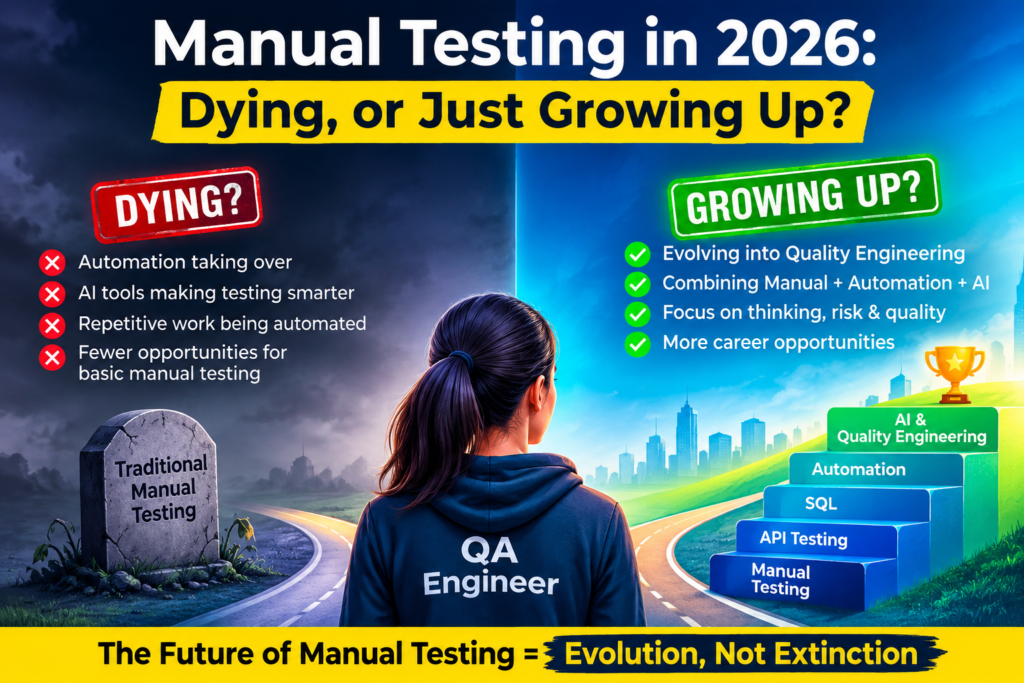
Manual testing in 2026 is not dying — it is evolving.
As automation, artificial intelligence, API testing, SQL, and modern QA tools become more common, the role of a manual tester is changing.
- What Does Manual Testing in 2026 Actually Involve?
- Automation Is Replacing Repetitive Testing
- AI Is Changing Test Design
- What if the payment succeeds but the confirmation call times out?
- What if the user double-taps “Pay” on a slow connection?
- What if the network drops immediately after the payment succeeds?
- What if a refund is triggered for a transaction that never technically completed?
- Tester A
- Tester B
- 1. Strengthen Manual Testing Fundamentals
- 2. Learn API Testing
- 3. Learn SQL and Database Testing
- 4. Learn Test Automation
- 5. Learn How to Use AI in Testing
- If you’re 0–2 years into QA
- If you’re a mid-career tester with 3–5 years of experience
- If you’re leading a QA team
- Is manual testing dying in 2026?
- Will AI replace manual testers?
- Should manual testers learn automation?
- What skills should manual testers learn in 2026?
- Is manual testing a good career in 2026?
- Is manual testing better than automation testing?
- The Future of Manual Testing in 2026
Repetitive test execution is increasingly being automated, but exploratory testing, risk analysis, usability testing, critical thinking, and understanding real user behavior remain essential.
Manual testing in 2026 is changing from repetitive test execution toward exploratory testing, risk analysis, API validation, database testing, automation, and AI-assisted quality engineering.
The real question isn’t whether manual testing will disappear.
The better question is:
What skills will manual testers need to stay relevant in 2026 and beyond?
In this guide, we’ll explore the future of manual testing, the impact of automation and AI, which QA jobs are most at risk, and the practical skills testers can build to grow their careers.
What Does Manual Testing in 2026 Actually Involve?
It’s easy to reduce manual testing to “clicking buttons,” but that seriously undersells the job.
Take something as simple as a login screen.
A thorough manual tester isn’t just checking whether valid credentials work. They are asking questions such as:
- What happens with a correct username but wrong password three times in a row?
- Does the application behave differently on a slow 3G connection compared with Wi-Fi?
- What does the error message actually communicate to a confused user?
- Does the session survive a phone call interrupting the app during login?
- Is the password field readable to a screen reader?
- What happens when the user refreshes the page during login?
- Can a user paste unexpected characters into the input fields?
- Does the login experience work consistently across browsers and devices?
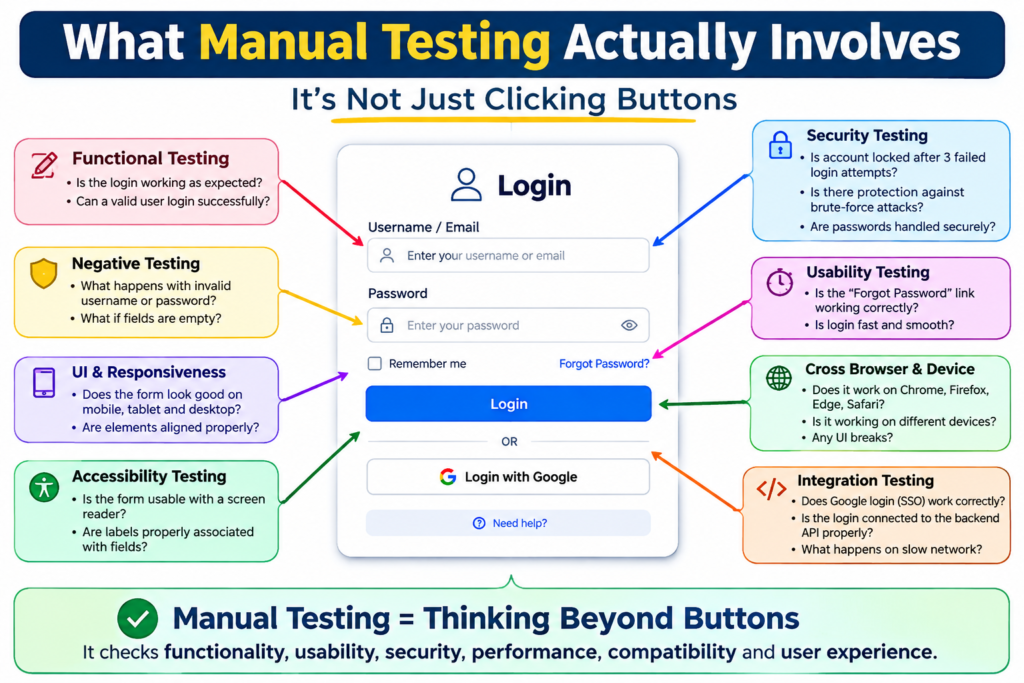
This is why manual testing is more than executing test cases.
A strong tester builds a mental model of how software works, how users behave, and how systems can fail.
That mental model is exactly what makes human testing valuable.
Why Do People Think Manual Testing Is Dying?
Every few months, a new wave of panic sweeps through QA communities.
Someone posts:
“Automation will replace manual testers.”
Someone else says:
“AI is coming for your job.”
And suddenly, testers start wondering whether they should have chosen a different career.
There is some truth behind the concern — but the conclusion is often wrong.
The future of manual testing isn’t about doing the exact same work forever.
It’s about changing what testers spend their time doing.
Automation Is Replacing Repetitive Testing
No QA team wants a person manually re-running the same 2,000 regression checks every release cycle.
That work is:
- Slow
- Repetitive
- Error-prone
- Difficult to scale
- Time-consuming
Tools such as Playwright, Cypress, Selenium, Appium, and Postman help teams automate repetitive and predictable testing activities.
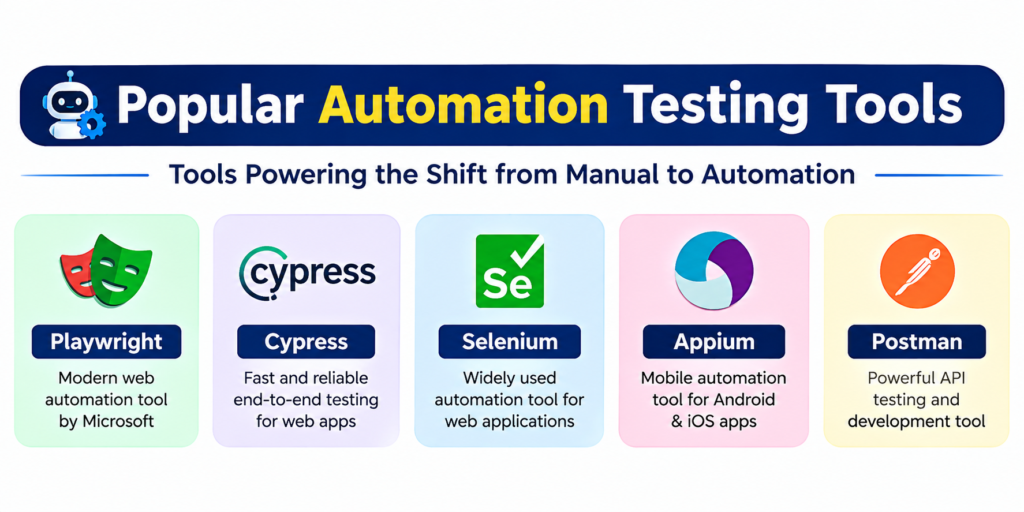
So yes, the repetitive execution side of manual testing is shrinking.
But repetitive execution was never the most valuable part of testing.
It was simply the part that used to consume the most time.
Automation can execute the same test hundreds of times.
But a tester still needs to decide:
Which tests should be automated?
Which tests are actually important?
What risks are we missing?
What should a human explore?
That’s where testing expertise matters.
AI Is Changing Test Design
Artificial intelligence is also changing the way QA professionals work.
Ask an AI tool to draft test scenarios for a signup form, and it can quickly suggest:
- Valid inputs
- Empty fields
- Invalid emails
- Weak passwords
- Boundary values
- Duplicate accounts
- Special characters
What might previously have taken a tester 20 minutes to draft can now become a starting point in seconds.
That’s a genuine shift.
But notice what AI has actually changed.
It has reduced the drafting effort.
It hasn’t eliminated the need for judgment.
A tester still needs to look at the AI-generated scenarios and ask:
“What did it miss?”
That question is extremely important.
What Can AI Still Not Replace in Software Testing?
Consider a payment flow.
An AI assistant can suggest standard scenarios:
- Successful payment
- Declined card
- Expired card
- Insufficient funds
- Invalid card details
All of these are useful.
But an experienced tester pushes further.
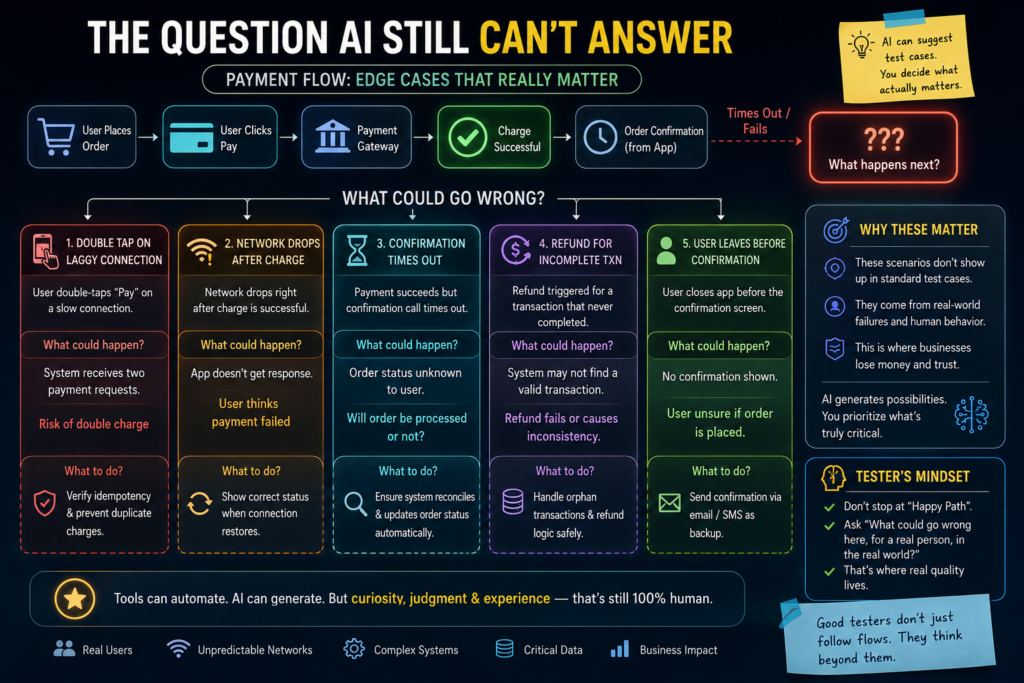
What if the payment succeeds but the confirmation call times out?
The customer may have been charged but still see a failed payment message.
What if the user double-taps “Pay” on a slow connection?
Could the system process two payment requests?
Could the customer be charged twice?
What if the network drops immediately after the payment succeeds?
The payment gateway may have completed the transaction, but the application may never receive the response.
What does the system do then?
What if a refund is triggered for a transaction that never technically completed?
Could the refund system create an inconsistent transaction state?
These aren’t just theoretical questions.
They come from understanding how real systems, networks, users, and distributed services can fail.
That’s the difference between a tool that can generate test ideas and a tester who can judge which risks actually matter.
Manual Testing vs Automation: What Should Be Automated?
The future isn’t about choosing between manual testing and automation.
The strongest QA teams use both.
Automation is particularly useful when a test is:
- Repetitive
- Stable
- Predictable
- Frequently executed
- Time-consuming to perform manually
- Important for regression testing
For example, a stable login regression test can be automated and executed hundreds of times.
But manual testing remains valuable when a scenario requires:
- Exploratory thinking
- Usability evaluation
- Visual judgment
- Real-world user behavior
- Unpredictable combinations
- Business-risk analysis
- Investigation of unexpected behavior
The goal isn’t:
“Automate everything.”
The better goal is:
“Automate what doesn’t need a human anymore.”
This gives testers more time to investigate the things automation cannot easily discover.
Reframing the Real Problem
The threatened category was never really manual testing.
It was testing that adds no new information.
Compare two testers.
Tester A
“I ran the same 500-case regression suite again this sprint.”
Tester B
“I found a data-integrity risk in the new refund flow, automated the stable regression cases so the team stopped losing a day to them, and used AI to speed up drafting edge cases for the new feature — then spent the time I saved actually exploring it.”
Tester B isn’t doing less manual testing.
They’re doing sharper manual testing.
They’ve removed repetitive work and used that saved time for exploration, analysis, and risk identification.
That’s the direction in which QA testing in 2026 is moving.
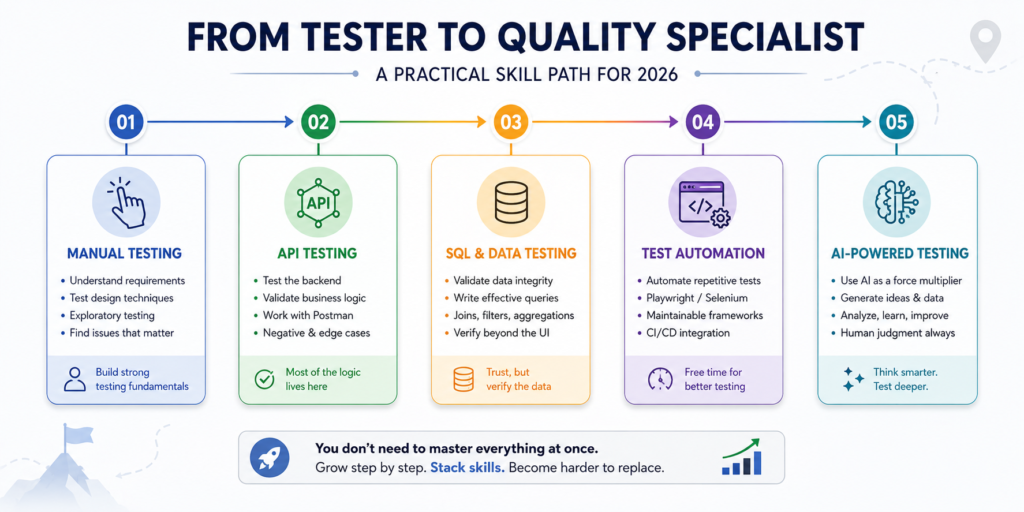
A Practical Skill Path for Manual Testers in 2026
You don’t need to become a full-stack automation engineer overnight.
If you’re wondering how to grow as a manual tester in 2026, the best approach is to build your skills progressively.
Think of it as a roadmap:
Manual Testing → API Testing → SQL → Test Automation → AI
You don’t need to master everything at once.
1. Strengthen Manual Testing Fundamentals
Start with the foundation.
Learn:
- Boundary Value Analysis
- Equivalence Partitioning
- Decision Table Testing
- State Transition Testing
- Risk-Based Testing
- Exploratory Testing
- Negative Testing
- Defect Analysis
- Requirement Analysis
No amount of automation or AI can compensate for weak testing fundamentals.
A tester who doesn’t know what to test won’t become a strong tester simply by learning a tool.
2. Learn API Testing
Modern applications depend heavily on APIs.
A UI may look simple, but much of the actual business logic happens behind the interface.
Get comfortable with:
- HTTP methods
- GET, POST, PUT and DELETE
- Headers
- Request parameters
- Authentication
- Tokens
- Status codes
- Response validation
- JSON
- Negative API testing
Tools such as Postman can help you understand and test APIs without requiring you to become a backend developer.
Most importantly, don’t test only the happy path.
Ask:
What happens when the API receives something it wasn’t expecting?
That’s where many valuable bugs are found.
3. Learn SQL and Database Testing
You don’t need DBA-level SQL skills to become a better QA tester.
Start with:
SELECTWHEREORDER BYGROUP BYJOIN- Aggregate functions
- Basic data validation
Imagine the application displays:
“Registration successful.”
A strong tester doesn’t necessarily stop there.
They can verify whether the correct record actually reached the database.
Was the user created?
Was the correct email stored?
Was the correct status assigned?
Was duplicate data created?
This is where SQL for QA testers becomes extremely useful.
4. Learn Test Automation
Once your testing fundamentals are strong, add automation.
You don’t need to automate every scenario.
Start with stable and repetitive tests.
For web applications, Playwright is a strong modern option.
Learn:
- Locators
- Assertions
- Test structure
- Test data
- Page Objects
- Reusable functions
- Reporting
- Parallel execution
- CI/CD integration
The goal isn’t:
“I need to automate everything.”
The goal is:
“I need to automate the tests that don’t require human judgment.”
5. Learn How to Use AI in Testing
AI can become a productivity tool for QA professionals.
You can use AI to:
- Generate initial test ideas
- Identify possible edge cases
- Create test data
- Explain error messages
- Suggest potential root causes
- Review requirements
- Generate automation code
- Improve documentation
- Brainstorm negative scenarios
But don’t blindly trust AI output.
Treat AI as a second pair of eyes, not the final decision-maker.
A good workflow is:
AI generates → Tester reviews → Tester improves → Tester validates
Never ship AI-generated test cases or automation code without reviewing and testing it yourself.
Which Manual Testing Jobs Are Actually at Risk?
Being direct about this matters more than simply being reassuring.
The biggest risk isn’t to manual testing as a whole.
The bigger risk is to QA roles built almost entirely around highly repetitive and predictable work.
Roles involving the following activities are becoming easier to automate:
- Repeating the same regression suite release after release
- Basic UI smoke checks
- Simple and predictable data validation
- Standard API checks
- Repetitive test execution
- Testing without deeper analysis
But testers who combine:
Manual Testing + API Testing + SQL + Automation + AI
can bring much more value.
The future QA professional doesn’t necessarily need to become a full-time developer.
Instead, they need to become a quality-focused professional who understands the product, technology, users, and business risks.
The question isn’t:
“Can I code as well as a developer?”
The better question is:
“Can I identify risks that an automated script might never discover?”
The Most Important QA Skill: Curiosity
Manual testing in 2026 requires more than following predefined test cases; it requires curiosity and the ability to think beyond the expected workflow.
Give a normal test case a phone number field.
The basic test might check:
Does
9876543210get accepted?
Fine.
But a curious tester keeps going.
- What about a 9-digit number?
- What about an 11-digit number?
- What about spaces?
- What about dashes?
- What about letters mixed with numbers?
- What happens when the user pastes the number from a contacts application?
- What happens when the network drops during submission?
- What happens if the user taps Submit multiple times?
- What happens if the application is minimized during submission?
This instinct to keep going after “it worked” is one of the most valuable qualities a tester can have.
Curiosity leads to better questions.
Better questions lead to better test coverage.
And better test coverage leads to better software.
What Does the Future of Manual Testing Look Like?
The future of manual testing is not simply:
Manual → Automation → No Testers
It’s closer to:
Manual Testing → Quality Engineering → Human Judgment + Automation + AI
The role is changing.
A tester may spend less time executing repetitive test cases and more time:
- Understanding requirements
- Identifying risks
- Exploring new features
- Validating APIs
- Checking databases
- Designing automation
- Reviewing AI-generated scenarios
- Investigating failures
- Thinking about real users
This is not the disappearance of testing.
It’s the evolution of testing.
Where This Actually Leaves You
Your career stage can determine what you should focus on next.
If you’re 0–2 years into QA
Focus on:
Manual Testing → API Testing → SQL → Basic Automation
Build strong fundamentals before worrying about advanced tools.
If you’re a mid-career tester with 3–5 years of experience
Focus on:
Exploratory Testing → Risk-Based Testing → API → SQL → Automation → AI
Start thinking beyond test execution.
Understand why defects happen and which risks matter most to the product.
If you’re leading a QA team
Your job increasingly involves deciding:
- What should be automated?
- What requires human testing?
- Which risks matter most?
- How should AI be used?
- How can the team reduce repetitive work?
- How can testers spend more time on meaningful quality activities?
Leadership in QA isn’t about executing more test cases.
It’s about making better quality decisions.
Frequently Asked Questions About Manual Testing in 2026
Is manual testing dying in 2026?
No. Manual testing is evolving rather than disappearing. Automation and AI are reducing repetitive testing work, but exploratory testing, usability testing, risk analysis, and human judgment remain important.
Will AI replace manual testers?
AI can automate parts of test design, test data creation, documentation, and repetitive QA tasks. However, testers still need to understand business risks, user behavior, system behavior, and unexpected failures.
Should manual testers learn automation?
Yes.
Manual testers don’t necessarily need to become expert software developers, but learning automation can make them more effective and open up additional QA career opportunities.
What skills should manual testers learn in 2026?
A practical learning path is:
Manual Testing → API Testing → SQL → Test Automation → AI for Testing
Build these skills progressively instead of trying to master everything simultaneously.
Is manual testing a good career in 2026?
Yes, but the skill requirements are changing.
Testers who combine strong testing fundamentals with API testing, SQL, automation, and AI skills can remain highly valuable.
Is manual testing better than automation testing?
Neither is universally better.
Manual testing is valuable for exploratory testing, usability, risk analysis, and scenarios requiring human judgment.
Automation is valuable for repetitive, stable, and frequently executed tests.
The strongest QA approach combines both.
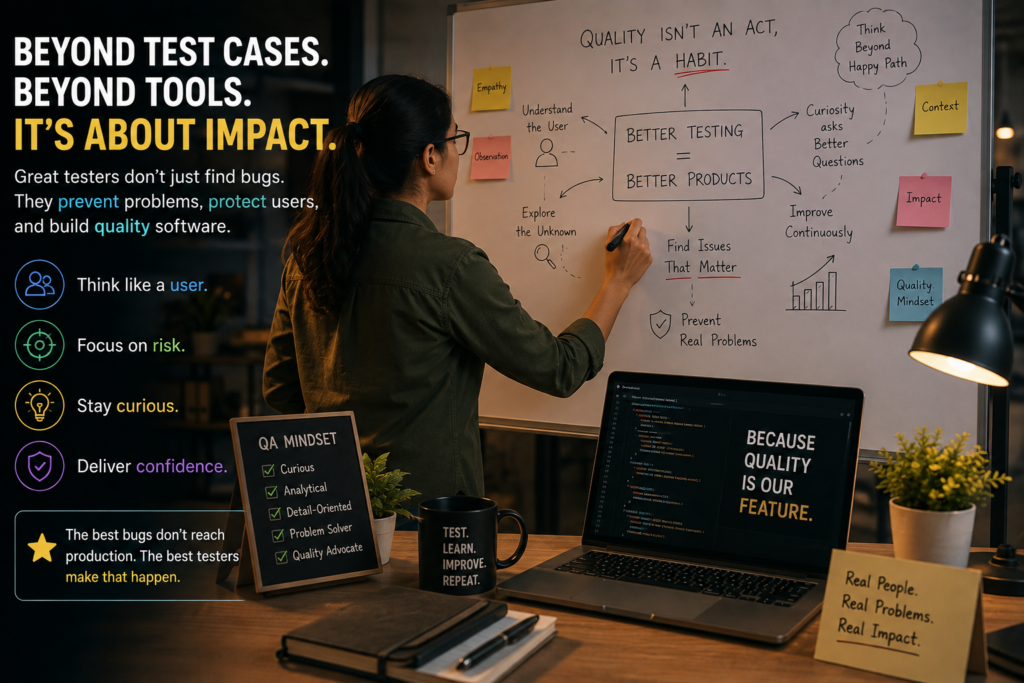
The Future of Manual Testing in 2026
The future of manual testing in 2026 is closely connected with automation, API testing, SQL, artificial intelligence and quality engineering. Manual testers who continue developing these skills can remain valuable even as repetitive testing becomes increasingly automated.
The Bottom Line
Manual testing in 2026 is not disappearing. It is evolving.
The repetitive part of testing is increasingly being handled by automation and AI.
That doesn’t make testers less important.
It changes where their value comes from.
The strongest QA professionals will combine:
Manual Testing + API Testing + SQL + Automation + AI + Curiosity
You don’t have to master everything overnight.
Start with strong testing fundamentals.
Learn API testing.
Add SQL.
Build automation skills.
Then learn how to use AI as a productivity tool.
The goal isn’t to compete with AI.
The goal is to become the tester who knows how to use AI, automation, and technology while still asking the questions they can’t ask on their own.
Because the most valuable QA question is still:
“What could go wrong here for a real user in the real world?”
That’s where great testing begins.
One important takeaway: AI and automation can help testers execute faster, but they don’t replace the ability to think about risk, user behavior, business impact, and unexpected scenarios.
The future belongs to testers who combine testing fundamentals + technical skills + AI.
Excellent and very relevant article! 👏 The biggest takeaway is that manual testing is not disappearing—it is evolving. Automation and AI can handle repetitive tasks and help testers work faster, but critical thinking, curiosity, risk analysis, business understanding, and real-world user perspective are still invaluable.
I especially liked the practical roadmap: Manual Testing → API Testing → SQL → Automation → AI. This gives QA professionals a clear direction for building their skills step by step rather than feeling overwhelmed by the rapid changes in technology.
The future of QA is clearly about becoming a better quality-focused professional, not simply executing more test cases. Great insights!